<h1>What is Digital Marketing? A Beginner's Guide</h1>
<p>In today's hyper-connected world, having a strong online presence isn't just an option—it's essential for success. But where do you even begin? If you've been asking yourself, "<strong>what is digital marketing?</strong>", you've come to the right place. This guide will introduce you to the fundamental concepts of digital marketing.</p>
<p>We'll break down everything from the various channels to implementing basic strategies. Whether you're a business owner, a student, or simply curious about the online world, this ultimate <strong>digital marketing guide</strong> will provide you with a solid foundation. Let's dive in!</p>
<h2>Defining Digital Marketing: What It Is and Why It Matters</h2>
<p>At its core, digital marketing is simply any marketing effort that uses an electronic device or the internet. It's how businesses leverage digital channels like search engines, social media, email, and their websites to connect with current and prospective customers. It’s a massive umbrella term that covers a wide range of tactics and strategies.</p>
<p>Think about traditional marketing: billboards, magazine ads, and TV commercials. They push a message out to a broad audience, hoping to catch the right people. Digital marketing flips that model on its head. It’s about pulling people in who are already looking for your solutions.</p>
<h3>Why is Digital Marketing So Important?</h3>
<p>The importance of digital marketing can't be overstated. It levels the playing field, allowing small businesses to compete with large corporations. It offers incredible advantages, such as:</p>
<ul>
<li><strong>Global Reach:</strong> You aren't limited by geography. You can reach an international audience with a single campaign.</li>
<li><strong>Cost-Effective:</strong> Many digital marketing basics are far more affordable than traditional methods. You can start with a small budget and scale up.</li>
<li><strong>Targeted Audience:</strong> You can target specific demographics, interests, and behaviors, ensuring your message reaches the most relevant people.</li>
<li><strong>Measurable Results:</strong> Unlike a billboard, you can track almost every aspect of a digital campaign. You know what works and what doesn't, allowing you to optimize for better results.</li>
</ul>
<p>Understanding <strong>what is digital marketing</strong> is the first step towards harnessing its power for your own goals.</p>
<h2>The Core Components of Digital Marketing</h2>
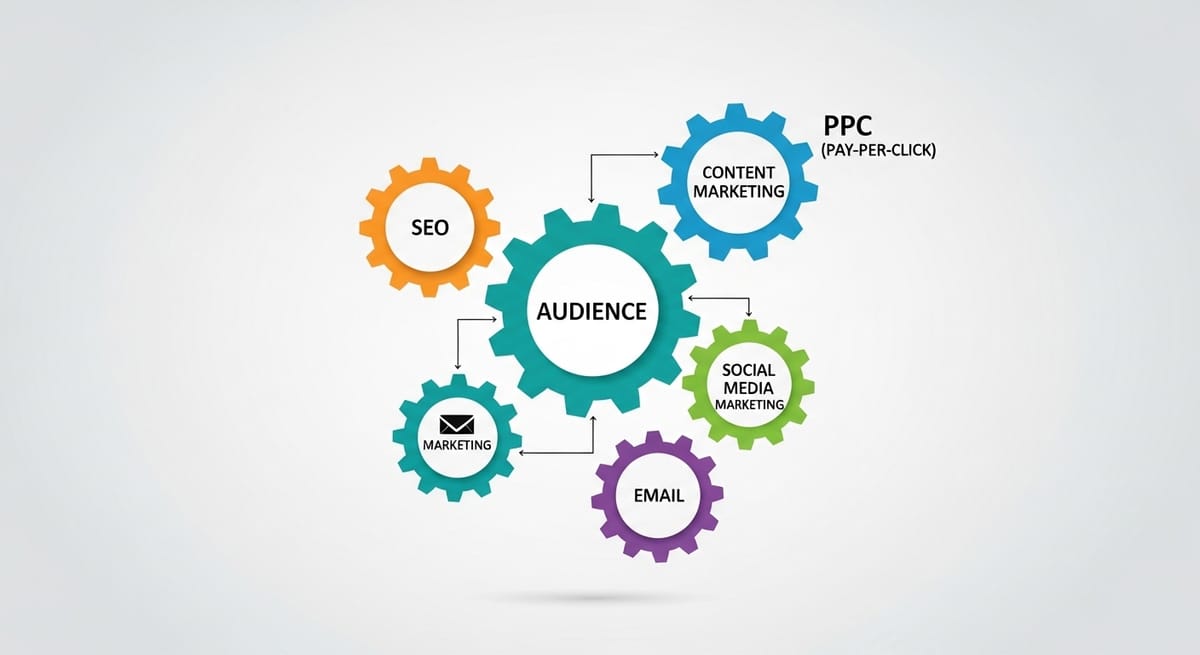
<p>Digital marketing isn't just one thing; it's a collection of different disciplines working together. For <strong>digital marketing for beginners</strong>, it's helpful to understand the main channels. These are the primary <strong>types of digital marketing</strong> you'll encounter:</p>
<ul>
<li><strong>Search Engine Optimization (SEO):</strong> This is the process of optimizing your website to rank higher in search engine results pages (like Google). The goal is to increase organic, or free, traffic to your site.</li>
<li><strong>Content Marketing:</strong> This involves creating and sharing valuable free content—like blog posts, videos, and podcasts—to attract and convert prospects into customers. It's about building trust and authority.</li>
<li><strong>Social Media Marketing (SMM):</strong> This is all about promoting your brand and content on social media channels to increase brand awareness, drive traffic, and generate leads.</li>
<li><strong>Email Marketing:</strong> A direct line to your audience. It's used to communicate with your customers, promote content, and share special offers, nurturing them toward a purchase.</li>
<li><strong>Pay-Per-Click (PPC) Advertising:</strong> This involves paying a fee each time one of your ads is clicked. The most common form is Google Ads, which allows you to pay for top slots on Google's search results pages.</li>
</ul>
<p>Each of these components can be a full-time job in itself, but a good strategy often involves a mix of several working in harmony.</p>
<img src="https://ghost.yurafa.net/content/images/2026/05/image-1-1-3.jpg" alt="What is Digital Marketing? The Ultimate Beginner's Guide">
<h2>Understanding Your Audience: The Foundation of Success</h2>
<p>Before you write a single blog post or create a social media ad, you must answer one critical question: who are you trying to reach? All successful marketing starts with a deep understanding of the target audience. Without this, your efforts are like shouting into a void.</p>
<p>This is where buyer personas come in. A buyer persona is a semi-fictional representation of your ideal customer based on market research and real data about your existing customers. It helps you humanize your target audience and tailor your messaging to their specific needs, goals, and pain points.</p>
<h3>How to Gather Audience Insights</h3>
<p>Creating an accurate persona isn't guesswork. You can gather valuable information by:</p>
<ul>
<li><strong>Surveying your existing customers:</strong> Ask them about their challenges, goals, and where they spend their time online.</li>
<li><strong>Using analytics tools:</strong> Google Analytics can tell you about the demographics and interests of your website visitors.</li>
<li><strong>Social media listening:</strong> Pay attention to conversations happening on platforms your audience uses. What questions are they asking?</li>
</ul>
<p>Once you know who you're talking to, every other part of your digital marketing strategy becomes clearer and more effective.</p>
<h2>Getting Started with Search Engine Optimization (SEO)</h2>
<p><strong>Search engine optimization (SEO)</strong> can seem intimidating, but the basics are quite straightforward. SEO is all about making your website more attractive to search engines like Google. When someone searches for a term related to your business, you want your website to appear as high as possible on the results page.</p>
<h3>On-Page SEO Basics</h3>
<p>On-page SEO refers to all the things you can do *on* your website to improve its ranking. This includes:</p>
<ul>
<li><strong>Keywords:</strong> These are the words and phrases people type into search engines. Integrating relevant keywords into your content tells Google what your page is about.</li>
<li><strong>Title Tags:</strong> This is the title of your page that appears in the browser tab and on the search results page. It should be concise and include your main keyword.</li>
<li><strong>Meta Descriptions:</strong> This is the short snippet of text under your title in search results. It doesn't directly impact rankings, but a good one entices users to click.</li>
</ul>
<h3>Off-Page SEO Explained</h3>
<p>Off-page SEO refers to actions taken *outside* of your own website to impact your rankings. The biggest factor here is backlinks. A backlink is a link from another website to yours. Think of each backlink as a vote of confidence, telling Google that your content is valuable and trustworthy.</p>
<h3>Short-Tail vs. Long-Tail Keywords</h3>
<p>Keywords come in two main flavors. Short-tail keywords are broad search terms, usually one or two words (e.g., "shoes"). They get a lot of search traffic but are highly competitive. Long-tail keywords are longer, more specific phrases (e.g., "best waterproof running shoes for men").</p>
<p>For beginners, targeting long-tail keywords is a smart strategy. They have less competition and the people searching for them are often closer to making a purchase.</p>
<h2>Creating Valuable Content: The Heart of Digital Marketing</h2>
<p>At the center of any great digital marketing strategy is great content. <strong>Content marketing</strong> is a strategic approach focused on creating and distributing valuable, relevant, and consistent content to attract and retain a clearly defined audience — and, ultimately, to drive profitable customer action.</p>
<p>Instead of pitching your products or services, you are providing truly useful content that helps your audience solve their problems. This builds trust and positions you as an expert in your field.</p>
<h3>Types of Content to Create</h3>
<p>Content marketing isn't just about blogging. There are many formats you can use to connect with your audience:</p>
<ul>
<li><strong>Blog Posts:</strong> The cornerstone of content marketing, perfect for SEO and providing in-depth information.</li>
<li><strong>Videos:</strong> Highly engaging and shareable. You can create tutorials, behind-the-scenes looks, or interviews. Creating engaging videos is easier than ever with tools like <a href="/api/affiliate-redirect?userId=QAceFw06x0gabrE27SP7AtcEB3x2&linkId=https%3A%2F%2Fblog.yurafa.online%2Fpictory&url=https%3A%2F%2Fblog.yurafa.online%2Fpictory" rel="noopener sponsored" target="_blank">Pictory</a>, which can turn scripts or articles into professional videos.</li>
<li><strong>Infographics:</strong> Great for presenting complex information and data in a visually appealing and easy-to-digest format.</li>
<li><strong>Ebooks:</strong> A longer form of content that allows you to dive deep into a topic, often used to generate leads.</li>
<li><strong>Podcasts:</strong> A growing medium that allows you to connect with an audience while they are multitasking.</li>
</ul>
<p>The key is consistency. Creating a content calendar can help you plan and publish content regularly, keeping your audience engaged and coming back for more.</p>
<h2>Leveraging Social Media to Connect and Engage</h2>
<p><strong>Social media marketing</strong> is more than just posting updates about your company. It's about building a community, engaging in conversations, and showing the human side of your brand. It’s a powerful tool for increasing brand awareness and driving traffic to your website.</p>
<img src="https://ghost.yurafa.net/content/images/2026/05/image-2-1-1.jpg" alt="What is Digital Marketing? The Ultimate Beginner's Guide">
<h3>Choosing the Right Platforms</h3>
<p>With so many social media platforms out there, it can be overwhelming. The trick is not to be everywhere, but to be where your audience is.
</p>
<ul>
<li><strong>Facebook:</strong> Has a massive, diverse user base, making it great for most B2C businesses.</li>
<li><strong>Instagram:</strong> A visual platform, perfect for brands in fashion, food, travel, and lifestyle.</li>
<li><strong>LinkedIn:</strong> The go-to platform for B2B marketing, networking, and professional content.</li>
<li><strong>TikTok:</strong> Dominated by short-form video content, ideal for reaching a younger audience with creative and entertaining posts.</li>
</ul>
<h3>Creating Engaging Content</h3>
<p>To succeed on social media, you need to create content that stops the scroll. This means focusing on value and entertainment, not just sales pitches. Encourage interaction by asking questions, running polls, and sharing content from your followers. Visuals are key, so invest time in creating high-quality images and videos.</p>
<h2>The Power of Email: Building Relationships and Driving Conversions</h2>
<p>In an age of social media, some might think <strong>email marketing</strong> is outdated. They couldn't be more wrong. Email is one of the most effective marketing channels because it's a direct, personal line of communication with people who have explicitly opted in to hear from you.</p>
<p>Email marketing is excellent for building relationships, nurturing leads, and promoting your products or services. It consistently delivers a high return on investment (ROI) when done correctly.</p>
<h3>Building Your Email List</h3>
<p>Your email list is one of your most valuable assets. To build it, you need to offer people a compelling reason to subscribe. This is often done with a "lead magnet," which is a free resource you offer in exchange for an email address. This could be a checklist, an ebook, a webinar, or a discount code.</p>
<h3>Segmentation and Personalization</h3>
<p>Not all subscribers are the same. Sending targeted emails to specific segments of your list will always outperform sending one generic "blast" to everyone. You can segment your list based on demographics, purchase history, or engagement level. This allows you to send more relevant and personalized content.</p>
<p>Managing lists, campaigns, and automation can be complex, but all-in-one platforms simplify the process. For example, a tool like <a href="/api/affiliate-redirect?userId=QAceFw06x0gabrE27SP7AtcEB3x2&linkId=https%3A%2F%2Fblog.yurafa.online%2Fsystemeio&url=https%3A%2F%2Fblog.yurafa.online%2Fsystemeio" rel="noopener sponsored" target="_blank">Systeme.io</a> can help you build sales funnels, manage email marketing, and sell products from a single dashboard, making it a great option for beginners.</p>
<h2>Measuring Your Success: Key Digital Marketing Metrics</h2>
<p>One of the biggest advantages of digital marketing is that everything is measurable. But with so much data available, it's easy to get lost. Focusing on a few key metrics will help you understand what's working and where you need to improve.</p>
<p>Here are some of the most important metrics for beginners:</p>
<ul>
<li><strong>Website Traffic:</strong> This tells you how many people are visiting your website. You can see which channels (organic search, social media, email) are driving the most visitors.</li>
<li><strong>Conversion Rate:</strong> This is the percentage of visitors who complete a desired action, like making a purchase or filling out a form. It's a crucial indicator of your website's effectiveness.</li>
<li><strong>Click-Through Rate (CTR):</strong> For emails and ads, this measures the percentage of people who clicked on a specific link. A low CTR might indicate your message isn't compelling enough.</li>
<li><strong>Social Media Engagement:</strong> This includes likes, comments, shares, and saves. It shows how well your content is resonating with your audience on social platforms.</li>
</ul>
<p>Tracking these metrics helps you make data-driven decisions instead of relying on guesswork, which is a cornerstone of effective digital marketing.</p>
<h2>Conclusion: Your Digital Marketing Journey Begins Now</h2>
<p>Digital marketing is a dynamic and ever-evolving field, but the core principles remain the same: understand your audience and provide them with value. We've covered a lot in this <strong>digital marketing for beginners</strong> guide, from explaining <strong>what is digital marketing</strong> to breaking down its core components like <strong>search engine optimization (SEO)</strong> and <strong>content marketing</strong>.</p>
<p>Don't feel like you need to master everything at once. The key is to start small, learn continuously, and adapt your strategy as you go. By starting with the fundamentals outlined in this guide, you can begin to build a strong online presence and achieve your marketing goals.</p>
<p>Your first step? Pick one area that excites you the most. If you love writing, start with content marketing and plan your first blog post. If you're a visual person, dive into social media marketing on Instagram. The most important thing is to get started. Good luck!</p>